Annual Reports
Cognizant Technology Solutions Corporation's annual reports contain management's most considered account of the business. These are the sections, passages and visual pages worth opening in the originals preserved in Sources.
Cognizant Technology Solutions Corporation — FY2025 Annual Report (Form 10-K) — FY2025 (year ended December 31, 2025)
Latest 10-K: management's fullest account of the pivot to an 'AI builder', the four industry segments, and how AI is both the growth engine and the biggest threat. · Open the full document →
Item 1. Business — Overview — p. 11 · Read the full section →
States who Cognizant now is: a professional-services firm repositioned as an 'AI builder' at the intersection of industry and technology.
Cognizant recast as an 'AI builder' — the opening identity statement of the 10-K.
Cognizant is one of the world’s leading professional services companies, engineering modern businesses and delivering strategic outcomes for our clients. We help clients modernize technology, reimagine processes and transform experiences so they can stay ahead in today's fast-changing world, where AI is reshaping organizations in every field. As an AI builder, we provide deep expertise at the intersection of industry and technology, combining our perspective with extensive knowledge of our clients' organizations to build industry-specific platforms and incorporate context into systems, AI models and custom solutions. We tailor our services and solutions to specific industries with an integrated global delivery model that employs client service and delivery teams based at client locations and dedicated global and regional delivery centers. Our services include consulting, application development, systems integration, quality engineering and assurance, engineering research and development, application maintenance, infrastructure and security as well as business process services and automation.
p. 11 · Read in context →
Reportable Business Segments — p. 13 · Read the full section →
Shows how demand differs across the four segments — Health Sciences and Financial Services are the clearest windows into what clients are buying.
What drives demand in Health Sciences and Financial Services — modernization, regulation and enterprise AI adoption.
Our HS segment consists of healthcare providers and payers, and life sciences companies, including pharmaceutical, biotech and medical device companies. Demand in this segment is driven by emerging industry trends, including the shift towards consumerism, outcome-based care, digital health and delivering seamless, patient-centered experiences. These trends result in increased demand for services that drive operational improvements in areas such as clinical development, pharmacovigilance and manufacturing, as well as claims processing, enrollment, membership and revenue cycle management. Demand is also created by the adoption and integration of digital technologies such as AI and predictive data analytics to improve clinical trial designs, data security, patient engagement and care outcomes.
Our FS segment includes banking, capital markets, payments and insurance companies. Demand in this segment is driven by our clients’ need to modernize legacy technology environments, strengthen operational resilience and adopt cloud, data and AI capabilities to meet evolving customer expectations and regulatory requirements. Our clients are expanding enterprise AI adoption to enhance customer experience, improve risk and fraud management, accelerate underwriting and lending and modernize payments. These initiatives require core platform modernization, greater use of advanced analytics and responsible AI frameworks to ensure transparency, security and compliance.
p. 13 · Read in context →
Services and Solutions — p. 15 · Read the full section →
How the offering is packaged: seven integrated practices, including the newest, Security — the taxonomy behind the revenue.
The seven practices Cognizant sells through, from Core Technologies to the new Security practice.
Our services and solutions are organized into seven integrated practices, which help us deliver these capabilities in ways that align with each client’s specific transformation journey. These practices are Core Technologies and Insights, Enterprise Platform Services, Industry Solutions, Intuitive Operations and Automation, Software and Platform Engineering, Cognizant Moment and our newest practice, Security.
p. 15 · Read in context →
Competition — p. 18 · Read the full section →
Names the direct competitors and the factors Cognizant competes on — a compact map of the IT-services rivalry.
Direct competitors (Accenture, TCS, Infosys, EPAM, HCL…) and the principal competitive factors.
The markets for our services are highly competitive, characterized by a large number of participants and subject to rapid change. Competitors may include systems integration firms, contract programming companies, application software companies, cloud computing service providers, traditional consulting firms, professional services groups of computer equipment companies, infrastructure management companies, outsourcing companies, boutique digital companies and clients' in-house technology resources, such as GCCs. Our direct competitors include, among others, Accenture, Atos, Capgemini, CGI, Deloitte Digital, DXC Technology, EPAM Systems, Genpact, HCL Technologies, IBM Consulting, Infosys Technologies, Tata Consultancy Services and Wipro. In addition, we compete with numerous smaller local companies in the various geographic markets in which we operate. For additional information, see Part I, Item 1A. Risk Factors.
p. 18 · Read in context →
Item 1A. Risk Factors — Intense and evolving competition — p. 27 · Read the full section →
Company-specific bite: smaller local rivals and clients' own captive centers (GCCs) undercut pricing and margins.
Local competitors and in-house Global Capability Centers as a lower-cost alternative to Cognizant.
The markets we serve and operate in are highly competitive, subject to rapid change and characterized by a large number of participants, as described in “Part I, Item 1. Business-Competition.” We compete on the basis of reputation and experience, strategic advisory capabilities, digital and AI capabilities, performance and reliability, responsiveness to customer needs, financial stability, corporate governance and competitive pricing of services. The less we are able to differentiate our services and solutions and/or clearly convey the value of our services and solutions, the more difficulty we have in winning new work in sufficient volumes and at our target pricing and overall economics. In addition to large, global competitors, we face competition in many geographic markets from numerous smaller, local competitors that may have more experience with operations in these markets, have well-established relationships with our desired clients, or be able to provide services and solutions at lower costs or on terms more attractive to clients than we can. Additionally, we face competition from clients' in-house technology resources, such as GCCs, which may provide a lower cost alternative to our services.
p. 27 · Read in context →
Item 1A. Risk Factors — Our use of AI technologies may not be successful — p. 27 · Read the full section →
The defining risk: the same AI Cognizant sells can replace the services it historically performed, cutting demand and pricing.
Why AI competitiveness is 'critical to our financial performance'.
We expect the proliferation of AI will have a significant impact on our industry, and we believe our ability to compete in this space will be critical to our financial performance. We increasingly use AI-based technologies, including GenAI, in our client offerings and our own internal operations.
p. 27 · Read in context →
AI cannibalization stated plainly — services 'replaced by AI or other forms of automation, including our own'.
Some services that we historically performed for our clients have been and will continue to be replaced by AI or other forms of automation, including our own AI-enabled client offerings. Each of the foregoing may lead to reduced demand for our services or harm our ability to obtain favorable pricing or other terms for our services, which could have a material adverse effect on our business, results of operations and financial condition.
p. 29 · Read in context →
Item 1A. Risk Factors — Cybersecurity incidents — p. 34 · Read the full section →
For a firm that hosts and processes client data worldwide, a breach is an existential, client-specific exposure.
Dependence on global IT networks to host clients' confidential data — and the breach exposure it creates.
In order to provide our services and solutions, we depend on global information technology networks and systems, to process, transmit, host and securely store electronic information (including our confidential information and the confidential information of our clients) and to communicate among our locations around the world and with our clients, suppliers, vendors and alliance partners (including numerous cloud service providers). Security breaches, employee malfeasance, or human or technological error have in the past and could in the future cause shutdowns or disruptions of our, our vendors' or our clients' operations and potential unauthorized access and/or disclosure of our or our clients’ sensitive data, which in turn could jeopardize projects that are critical to our operations or the operations of our clients’ businesses and have other adverse impacts on our business or the business of our clients.
p. 34 · Read in context →
Item 7. MD&A — Executive Summary: 2025 Results — p. 51 · Read the full section →
Management's own scorecard: 7% revenue growth and margin expansion, plus the one-off tax charge that split GAAP from adjusted EPS.
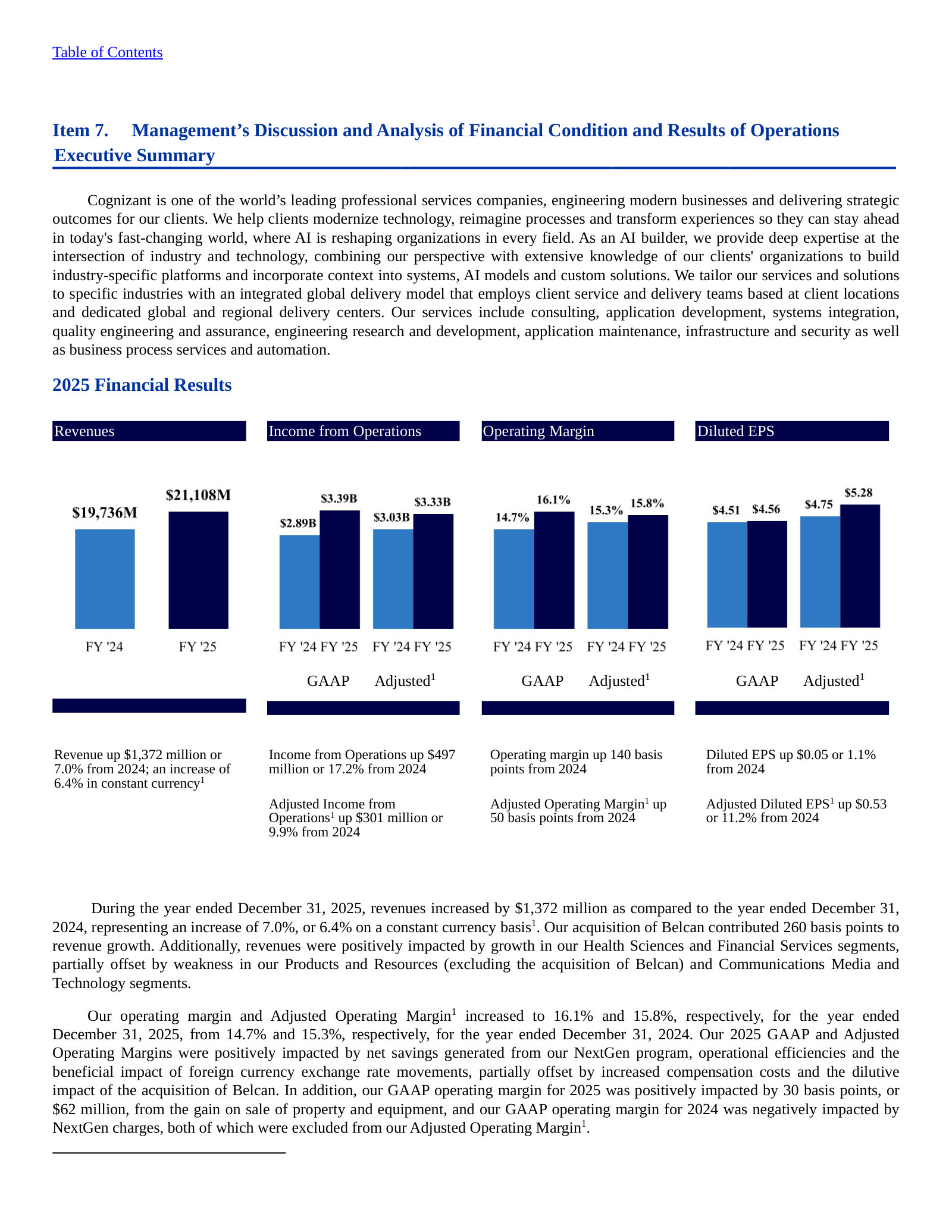
The $390M one-time tax charge from U.S. OBBBA R&E repeal that cut GAAP EPS by $0.80.
In July 2025, the OBBBA was enacted in the United States, which, among other provisions, repealed the requirement to capitalize U.S. R&E costs. As a result, we do not believe it is more likely than not that we will realize our deferred tax asset of $390 million related to R&E costs capitalized outside the United States. These amounts would have otherwise been available to offset certain future U.S. taxes on our non-U.S. earnings, which, as a result of this repeal, we no longer project to be applicable to us. Therefore, in the third quarter of 2025, we recorded a one-time, non-cash income tax expense of $390 million. This impacted our full year 2025 GAAP diluted EPS by $0.80, which is added back for the calculation of Adjusted EPS.
p. 53 · Read in context →
Note 1 — Revenue Recognition — p. 95 · Read the full section →
The accounting policy that defines an IT-services P&L: fixed-price work booked by the cost-to-cost (labor) method.
Five-step model and cost-to-cost recognition on fixed-price development and integration contracts.
Revenue Recognition. We recognize revenues as we transfer control of deliverables (products, solutions and services) to our clients in an amount reflecting the consideration to which we expect to be entitled. To recognize revenues, we apply the following five step approach: (1) identify the contract with a customer, (2) identify the performance obligations in the contract, (3) determine the transaction price, (4) allocate the transaction price to the performance obligations in the contract, and (5) recognize revenues when a performance obligation is satisfied. We account for a contract when it has approval and commitment from all parties, the rights of the parties are identified, payment terms are identified, the contract has commercial substance and collectibility of consideration is probable. We apply judgment in determining the customer’s ability and intention to pay based on a variety of factors, including the customer’s historical payment experience.
For performance obligations where control is transferred over time, revenues are recognized based on the extent of progress towards completion of the performance obligation. The selection of the method to measure progress towards completion requires judgment and is based primarily on the nature of the deliverables to be provided.
Revenues related to fixed-price contracts for application development and systems integration services, consulting or other technology services are recognized as the service is performed using the cost-to-cost method, under which the total value of revenues is recognized on the basis of the percentage that each contract’s total labor cost to date bears to the total expected labor costs.
p. 95 · Read in context →
Cognizant Technology Solutions Corporation — FY2021 Annual Report (Form 10-K) — FY2021 (year ended December 31, 2021)
Included to show the strategy reset: the FY2021 'digital era' positioning (IoT/data/cloud, two practices) against which the FY2025 'AI builder' pivot stands out. · Open the full document →
Item 1. Business — Overview & Services (2021) — p. 7 · Read the full section →
The pre-AI identity — 'engineering modern business for the digital era', investing in IoT, data and cloud — same purpose and vision, different engine.
2021 self-description: 'the digital era', with four investment areas — IoT, digital engineering, data and cloud.
Cognizant is one of the world’s leading professional services companies, engineering modern business for the digital era. Our services include digital services and solutions, consulting, application development, systems integration, application testing, application maintenance, infrastructure services and business process services. Digital services have become an increasingly important part of our portfolio, aligning with our clients' focus on becoming data-enabled, customer-centric and differentiated businesses. We are continuing to invest in digital services with a focus on four key areas: IoT, digital engineering, data and cloud.
p. 7 · Read in context →
Services organized into just two practices in 2021 — before the seven-practice, AI-led structure of FY2025.
In 2021, our services and solutions were organized into two practice areas: Digital Business & Technology and Digital Business Operations. Our consulting professionals have deep industry-specific expertise and work closely with our practice areas to create modern frameworks, platforms and solutions that leverage a wide range of digital technologies across our clients’ businesses to deliver higher levels of efficiency and new value for their customers.
p. 11 · Read in context →
More annual reports
Cognizant Technology Solutions Corporation — FY2024 Annual Report (Form 10-K) — FY2024 · 148 pages · First 10-K with the mandated Item 1C. Cybersecurity disclosure and the maturing AI-services narrative under CEO Ravi Kumar S. · Open →
Cognizant Technology Solutions Corporation — FY2023 Annual Report (Form 10-K) — FY2023 · 149 pages · CEO-transition year; documents the segment structure and early GenAI investment framing. · Open →
Cognizant Technology Solutions Corporation — FY2022 Annual Report (Form 10-K) — FY2022 · 143 pages · Bridges the 'digital' era to the AI era — useful baseline for margins and headcount before the AI pivot. · Open →